
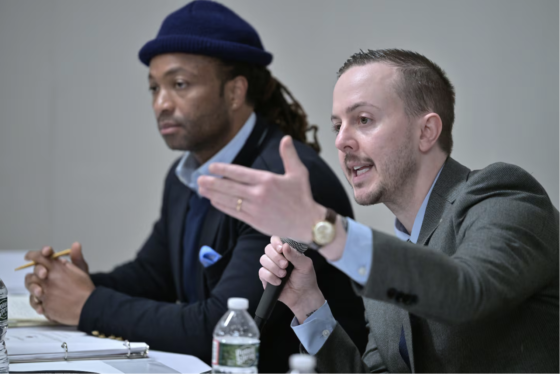
[Source via Boston Globe By Lea Skene]
Leaders of Boston’s civilian police oversight agency have subpoenaed several officers to appear at their meeting Thursday, an unprecedented move that could create more friction with police brass as the independent city office seeks to assert its authority.
The subpoena vote came amid pressure from the public and growing tension between the Boston Police Department and the city’s Office of Police Accountability and Transparency, or OPAT, which has so far struggled to fulfill its mission. The Boston City Council voted to create the office five years ago, in the wake of George Floyd’s murder and subsequent racial justice protests.
Mayor Michelle Wu has pledged support for the agency since her time on the City Council. But agency leaders now say that Police Commissioner Michael Cox, whom Wu appointed to head the department in 2022, isn’t taking their findings seriously.
OPAT executive director Evandro Carvalho said issuing subpoenas marks a turning point for the office.
“This is a significant … step forward in the execution of the duties of our agency,” Carvalho said after the vote.
Neither the Boston Police Department nor the mayor’s office commented for this story. It’s not clear if the department has given any directive to the subpoenaed officers.
When OPAT was first created,city leaders chose to give the office subpoena power, a significant allowance aimed at boosting its relevance and ensuring cooperation from police. That allows the agency to compel officers to appear for interviews, demand investigative materials, and more.
But until recently, the power went unused — even as OPAT officials complained about a lack of cooperation from officers and department leadership.
Finally, officials voted last month to subpoena a list of officers to appear at a public meeting slated for Thursday morning. It was a unanimous vote of the OPAT Commission, which includes Carvalho, along with Sam Harold, chair of the agency’s Civilian Review Board, and Anthony Fugate, chair of its Internal Affairs Oversight Panel.
After taking over leadership of OPAT in 2024, Carvalho has often asked for patience as he sought to stabilize the beleaguered agency, which had been beset by staff turnover, vacancies, and a lack of productivity. He pledged to make OPAT more effective, efficient, and public-facing.
Nine officers have been served with subpoenas, Carvalho said Tuesday morning. He declined to release a list of the subpoenaed officers.
If they comply with the subpoenas, their testimony before the Civilian Review Board will likely take place in executive session, without public access. The board plans to consider several cases during its upcoming meeting, Carvalho said. Board members could then vote on whether individual allegations of police misconduct are sustained or unfounded.
If the officers don’t show up, OPAT could take them to Superior Court and ask a judge to enforce the subpoenas. But it’s unclear exactly how that process would play out.
During a recent community forum on police reform in Boston, Harold said the process is complicated because both OPAT and BPD are part of city government, so engaging in some sort of power struggle could get messy.
“We’re trying to figure out how it all works,” he said. “It’s a little convoluted, unfortunately.”
Larry Calderone, president of the Boston Police Patrolmen’s Association, said it’s completely up to union members whether they participate in OPAT investigations.
“If they choose to take part in the process, that is completely up to the individual officer,” he said.
However, two smaller unions representing police department employees have expressed opposition to the process.
The Boston Police Superior Officers Federation, which represents police supervisors, asserted in a 2023 letter that “sworn officers are not expected or required to participate in OPAT investigations, and will not suffer any harm or adverse inference for failing to do so.”
Service Employees International Union Local 888, which represents the department’s civilian employees, also said in a January 2025 letter that “Local 888 and its bargaining unit members will not attend OPAT meetings.”
Leaders from those unions didn’t immediately respond to emails seeking comment.
Friction has been growing in recent months.
In a September letter to department leadership, the Civilian Review Board complained that many Boston police officers have refused to cooperate in its investigations, while Cox has often ignored their recommendations.
That includes a case in which the board recommended termination for an officer who detained, tackled, and punched a teenager. Instead of getting fired, the officer received a written reprimand for violating the department’s body camera policy.
“Boston cannot move forward with a police accountability system that is ignored by police leadership and employees,” the letter said. “We urge your leadership to correct this and recommit to a vision of public safety rooted in transparency, community trust, and justice.”
In a response letter last month, Cox promised better collaboration, including efforts to reduce backlogs and improve response times. But he said any disciplinary decisions must be based on the findings of an internal affairs investigation, per state law, collective bargaining agreements, and department rules and procedures.
OPAT leaders disagree with Cox’s argument, and they’re drafting another letter as the public negotiation continues.