
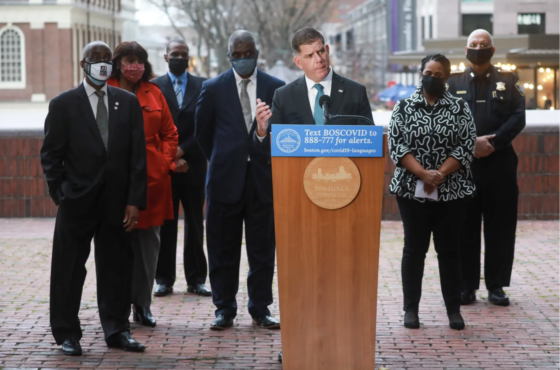
[Source via Boston Herald by Ed Gaskin]
Recent events underscore the stakes. In March 2026, Boston police shot and killed a carjacking suspect in Roxbury — a case that has since led to a manslaughter charge against an officer and ongoing disputes over the release of body-camera footage. When even the most high-profile cases leave the public with unanswered questions, it raises a deeper concern: whether the city’s oversight system is functioning as intended. Even in a relatively safer city, when serious incidents occur, the system can still struggle with transparency and accountability.
Five years after Boston promised sweeping police reform in the wake of the 2020 protests, the public still lacks clear evidence that those reforms are working.
In the aftermath of nationwide protests over policing and racial justice in 2020, Boston convened the Police Reform Task Force to examine the policies and practices of the Boston Police Department and recommend reforms to improve transparency, accountability, and community trust. The task force — made up of civic leaders, legal experts, clergy, and community representatives — spent months reviewing research and hearing from residents.
The result was a sweeping set of reforms that Boston’s political leadership pledged to implement.
Among the most significant changes was the creation of the Office of Police Accountability and Transparency (OPAT). The agency oversees two key bodies: a Civilian Review Board that investigates complaints from residents and an Internal Affairs Oversight Panel that monitors the Boston Police Department’s disciplinary process. Together, these institutions were designed to create an independent system of civilian oversight capable of strengthening both police legitimacy and public trust.
At the time, the reforms were widely praised by residents, policymakers, and the media. Boston appeared ready to build a modern system of accountability.
But the real question today is simple: Did Boston actually implement the reforms it promised?
Reports from news outlets and community advocates indicate that OPAT and other oversight bodies continue to face resistance when requesting information or cooperation from the police department. According to reporting by GBH News, officers have at times declined to participate in OPAT interviews, limiting the agency’s ability to independently investigate complaints.
Disciplinary recommendations issued by the Civilian Review Board are advisory rather than binding. Police officials have argued that some oversight requests conflict with existing procedures or legal protections for officers.
But without transparency about how these conflicts are resolved — and without a clear process for addressing them — the credibility of Boston’s entire reform framework is at risk.
Police reform ultimately succeeds or fails on a single question: does the public believe the system is fair and transparent?
Trust is not built through speeches or press conferences. It is built through accountability and transparency.
That is why the Boston City Council should act now.
The Boston City Council should hold a public oversight hearing bringing together the officials responsible for implementing the city’s police reform framework: Boston Police Commissioner Michael Cox, leadership from the Boston Police Patrolmen’s Association, and the heads of the city’s oversight bodies — including OPAT Executive Director Evandro Carvalho, Civilian Review Board Chair Sam Harold, and Internal Affairs Oversight Panel Chair Anthony Fugate.
Such a hearing would serve several important purposes.
First, it would allow the public to understand whether the tensions between the police department and the oversight system stem from policy disagreements, legal constraints, or simple resistance to reform.
Second, it would allow city leaders to determine whether Boston’s current laws or ordinances need to be strengthened. If civilian oversight is to mean anything, its findings must carry real authority.
Members of the original Police Reform Task Force should also be invited to testify regarding whether the current system reflects the reforms they intended.
Third, it would reaffirm a basic principle: police reform is not about weakening law enforcement. It is about strengthening trust between the police and the communities they serve.
Transparency also requires addressing another longstanding concern: delays in responding to public records requests.
Improving access to public information was one of the core promises of Boston’s reform process. If the public cannot obtain timely information about how the oversight system functions, the promise of reform risks becoming largely symbolic.
Recent events illustrate why transparency still matters. On Sept. 11, 2025, an unidentified man died following a “brief struggle” during an encounter with Boston police at a Bay Cove Human Services facility in Mattapan. The incident was referred to the Suffolk County District Attorney’s office for investigation. Yet months later, the public still knows very little about what occurred. The man’s identity has not been publicly confirmed, and Boston City Councilor Brian Worrell called for the release of police body-camera footage citing conflicting accounts of the encounter.
This example underscores the larger issue facing Boston’s reform effort. Oversight systems only build public trust when they produce transparency. When critical information remains unavailable months after a death following a police encounter, it reinforces the perception that the oversight framework is not yet delivering the accountability residents were promised.
Boston is not alone in facing these challenges. Cities across the country that pledged reform in 2020 are still struggling to translate those commitments into fully functioning oversight systems.
But Boston should strive to lead.
Five years ago, Boston promised residents a system of civilian oversight that would make policing more transparent and accountable.
When a man can die following a police encounter and the public still does not know what happened — or even who he was — it is clear that promise remains unfinished.
Because in the end, police reform is not about politics.
It is about trust.
And trust, once promised, must be delivered