
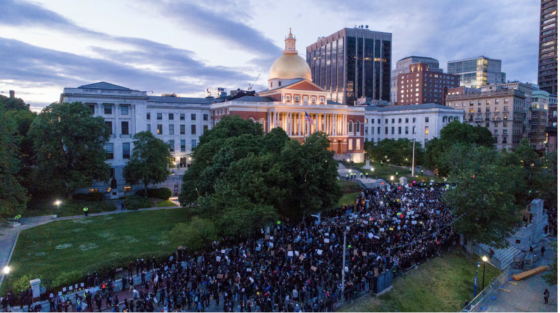
[Source via Boston Globe by Nick Stocio]
The city of Boston has agreed to pay $850,000 to settle a federal civil rights lawsuit brought by four protesters who accused police officers of beating and pepper-spraying them during demonstrations on Boston Common in the days after George Floyd’s murder in 2020.
The settlement, announced last week, resolves the claims brought by Jasmine Huffman, Justin Ackers, Caitlyn Hall, and Benjamin Chambers-Maher, who alleged they were subjected to excessive force while peacefully protesting on May 31, 2020. None of the four were charged with any crimes, their attorneys said.
“Our clients filed this lawsuit for the same reason they were on the Common that night in the first place: to stand up against police violence,” Mark Loevy-Reyes, a lawyer who represented the protesters, said in a statement. “The message sent today is the same one they were sending that night: we all have a right to expect better of our law enforcement officers.”
City and police officials did not immediately respond to messages seeking comment.
The protesters accused Boston police officers Michael Burke, Edward Joseph Nolan, and Michael H. McManus of violating their constitutional rights by using batons and pepper spray as crowds were dispersing from the Common and nearby streets.
Each plaintiff was injured in separate encounters with police while attempting to leave the area after the protest, according to the lawsuit.
Ackers said he was riding his moped along Tremont Street when Burke struck him from behind with a wooden baton, knocking him to the ground, the lawsuit alleged. Huffman was hit with a baton near the Park Street MBTA station while standing with her hands raised, the lawsuit alleged, and was knocked to the pavement. Huffman later said officers stepped on her hands as they moved past her.
Hall was struck in the face by Nolan’s baton in Downtown Crossing after she tried to shield another protester who was being hit, according to the lawsuit. She briefly lost consciousness and later required stitches for a facial injury.
Chambers-Maher, a disabled veteran, said McManus pepper-sprayed him twice as he backed away and then ran into him with a bicycle, leaving him temporarily blinded and bruised.
In each instance, the plaintiffs said they were complying with police orders to disperse and were not engaged in any criminal activity. Their claims were supported in part by police body camera footage included in the civil complaint, which their attorneys said showed officers striking or spraying individuals who were attempting to leave.
After therally on Boston Common, crowds pelted police with bottles and cans, torched a police cruiser, damaged vehicles, and looted stores in Downtown Crossing and the Back Bay. Seven police officers were taken to the hospital and 40 people were arrested.
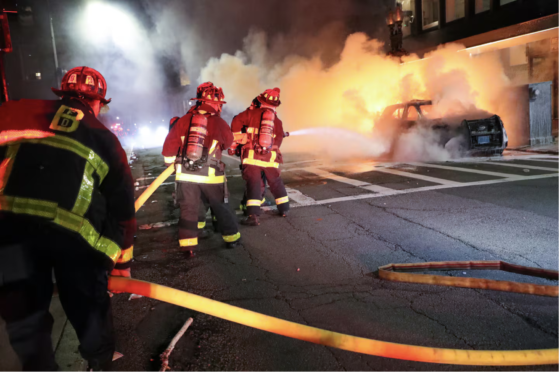
The plaintiffs attended the protest but did not participate in the violence and were not arrested, according to the lawsuit.
The lawsuit also accused the Boston police department of systemic failures, including inadequate planning for the protest, failure to investigate use-of-force incidents, and a culture that discouraged officers from reporting misconduct.
The complaint also alleged that the police commissioner at the time, William Gross, was aware that officers had used force against protesters during a demonstration two days earlier, on May 29, but did not take steps to ensure a non-violent response to subsequent protests. It further claimed that officers were equipped with wooden riot batons and permitted to use them without sufficient oversight.
City attorneys sought to dismiss the case several years ago, arguing in part that the officers did not know the individuals they encountered were protesters. But US District Judge Allison Burroughs rejected the argument, ruling that the allegations plausibly showed violations of the protesters’ First Amendment rights.
The settlements bring an end to nearly five years of litigation tied tothe rally on the Common to protest racial injustice and police violence following Floyd’s killing by a Minneapolis police officer.
Civil rights attorney Howard Friedman, who also represented the protesters, said the resolution reflects accountability.
“We are pleased that Boston saw the rightness of settling this lawsuit, and — as I have always hoped for in cases like these — that it will help lead to change and reform,” Friedman said in the statement.
Huffman said the experience continues to affect her.
“What happened that night will always be with me, but I am grateful that I was able to bring these issues to the federal court,” Huffman said. “I hope that the outcome leads to meaningful reform within the Boston Police Department.”