
[SOURCE via Boston Herald By: Gayle Cawley]
Boston City Councilor Sharon Durkan suggested that pulling back Council raises would lead to more corruption on the body like the recent federal bust of ex-Councilor Tania Fernandes Anderson for a $7,000 kickback scheme.
Durkan joined the majority of her colleagues in Wednesday’s 9-3 vote against a Council resolution that called for clawing back all raises included in 2022 legislation — $43,000 for Mayor Michelle Wu and $21,500 total for the Council. The defeated measure was aimed at restoring some of the proposed budget cuts.
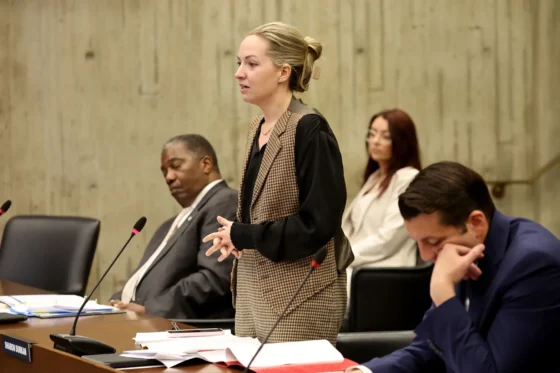
In explaining her opposition, Durkan said that while she could afford to live on the Council’s $103,500 salary that was in place before a series of tiered raises went into effect annually since January 2024, others may not be able to take a cut to their current $125,000 pay, particularly those who have to take care of their families.
Durkan then invoked the circumstances surrounding the December 2024 federal arrest and indictment of Fernandes Anderson on public corruption charges tied to a $7,000 City Hall kickback scheme while she was a councilor.
“We had a Council colleague… there was some corruption that took place on this body,” Durkan said. “I do not want anyone that serves in this body to not be able to afford their life and to go towards something that’s really dark and negative.”
Councilor Ed Flynn, who saw his push for an ethics committee killed by the Council amid the Fernandes Anderson corruption allegations, criticized Durkan for her remarks after the day’s meeting.
“As Boston elected officials, we should never justify or provide an excuse for any type of public corruption,” Flynn said in a statement to the Herald. “We must be held to high standards and lead by example. Ethics and integrity must be part of every aspect of city government.”
Fernandes Anderson pleaded guilty to charges tied to allegations made by the federal government that she gave one of her staff members, described as a relative but not immediate family member, a $13,000 bonus on the condition that $7,000 be kicked back to her. The handoff was coordinated by text and took place in a City Hall bathroom in June 2023, prosecutors said.
The federal indictment mentions that Fernandes Anderson may have been motivated, in part, by the “personal financial difficulty” she was facing at the time. Fernandes Anderson was staring down an impending $5,000 fine for a state ethics violation around that time period, for hiring two immediate family members to her City Council staff, giving them raises, and in the case of her sister, a bonus.
A financial disclosure form Fernandes Anderson filed with the city clerk in 2024 and that covered the year of 2023 showed she was $19,000 in debt at the time of the kickback scheme, for which she was convicted and served a month in jail for.
Fernandes Anderson was making $103,500 at the time of the kickback scheme, and then received annual raises for the remainder of her time on the Council — bringing her pay to $115,000 in 2024 and $120,000 in 2025. She resigned in July of last year, after her May conviction, but before her September sentencing.
The latest U.S. Census Bureau American Community Survey data show Boston’s median household income was approximately $97,344 for 2020–24, with 16.6% of people living in poverty.
The Council received its final pay raise under the Council-approved 2022 legislation in January, to bring salaries from $120,000 to $125,000.
Councilors Flynn and Erin Murphy said their resolution was aimed at shared sacrifice, with elected officials willing to take a pay cut while residents are facing service reductions next fiscal year, due to cuts in the mayor’s proposed $4.9 billion budget.
Murphy said the Council has seen a roughly 20% raise since the legislation took effect in early 2024, while other city employees see raises of about 1.5% to 2% each year as part of their collective bargaining agreements.
“Elected officials have a responsibility to demonstrate shared sacrifice, fiscal discipline, and accountability to the people they serve,” Murphy said. “Rescinding the salary increases for elected officials would send a clear message that the city’s priority must be preserving essential services, supporting our frontline workers, protecting vulnerable residents, and investing in the people and programs that serve Boston neighborhoods.”
Other councilors expressed doubts that savings from their collective pay cut would go toward restoring painful budget cuts.
Only one councilor, Miniard Culpepper, was willing to join Flynn and Murphy in voting in favor of the pay cut resolution. Julia Mejia abstained from taking a position by voting present, after saying she needed a guarantee that the savings would go toward preserving youth jobs. Gabriela Coletta Zapata was absent.
“I don’t mind reducing my salary, as long as that salary goes to supporting jobs,” Mejia said. “Any reduction in our pay should not become something that is symbolic and/or theatrical political poetry here. It should be a direct investment in Boston’s young people.”
That the vote went forward is somewhat surprising. Councilor Ben Weber, chair of the Ways and Means committee, said Tuesday he would block Flynn and Murphy’s resolution, given that he had “already informed (his) colleagues that any resolutions about budget policy decisions would be sent to committee.”
Weber voted against the resolution.
“I don’t support this,” Weber said. “I want to support my fellow councilors who are all very hardworking and have real expenses to deal with. We all have to make ends meet. … I just don’t think we can take the money and guarantee it goes somewhere, to Councilor Mejia’s request. As good as that request is, I think it just goes into the general fund.”