
[Source via Boston Globe by Nick Stoico]
A judge on Thursday acquitted former North Andover police officer Kelsey Fitzsimmons of pointing a gun at a fellow officer who shot her in the chest after arriving at her home to serve a restraining order in June.
In a detailed ruling from the bench, Judge Jeffrey Karp said prosecutors failed to prove Fitzsimmons aimed a gun at Officer Patrick Noonan before he shot her inside her home. Fitzsimmons had testified she kept the gun pointed at herself.
“Under these circumstances, I am left with a reasonable doubt, and I am duty bound to find that the Commonwealth has not met its burden,” Karp said.
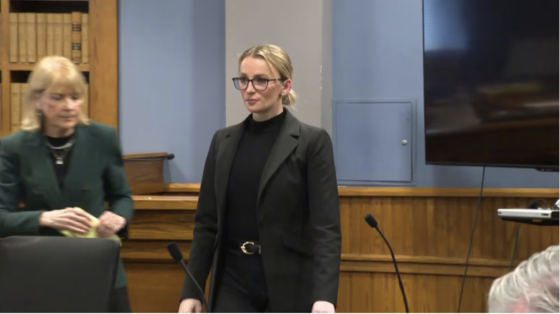
Fitzsimmons, 29, had opted for a bench trial on a sole count of assault with a dangerous weapon. She was seated between her attorneys, Timothy Bradl and Martha Coakley, who each took her hands in theirs as Karp announced his verdict, according to video from inside the courtroom by NBC10 Boston.
Fitzsimmons was charged in a June 30 incident at her North Andover home, where officers had arrived to serve a restraining order by her now-former fiancé, Justin Aylaian, a North Andover firefighter with whom she shares a son, who was born in February 2025.
On the witness stand, Fitzsimmons said she was overwhelmed and suicidal, and that she raised a gun to her own head. She testified that she never pointed the weapon at Noonan before he shot her.
Noonan had testified that Fitzsimmons pointed the gun at him, prompting him to fire.
Bradl urged Karp to reject that account, portraying Fitzsimmons as a woman in crisis whose life was unraveling in a matter of hours.
“June 30, 2025, was the worst day in Kelsey Fitzsimmons’ life,” Bradl said. “Her whole world imploded.”
Bradl said Fitzsimmons was attempting to take her own life after learning she could lose custody of her baby, her home, and her job.
“That day was about her, and she decided to end her life,” he said.
Karp said Fitzsimmons and Noonan were both credible witnesses on key points, an unusual circumstance that made the case “unusual and somewhat perplexing.”
He noted that both accounts unfolded in a matter of seconds in a cramped doorway, complicating efforts to determine what exactly happened.
During closing arguments, prosecutors argued that the physical evidence, particularly the condition of the firearm, contradicted Fitzsimmons’ version of the events.
The evidence showed her account as “scientifically and mechanically impossible,” Assistant District Attorney James Gubitose said.
He argued that “every piece of credible evidence” supported a guilty verdict.
Bradl countered that the case was fundamentally about a suicide attempt misinterpreted in a tense situation.
“That day was about her, and she decided to end her life,” he said. “Patrick Noonan … walked into a suicide in progress.”
Bradl argued Fitzsimmons had no motive to harm Noonan, a colleague she knew and trusted, and instead tried to isolate herself before retrieving the gun.
Karp rejected the prosecution’s claim that the firearm evidence conclusively disproved Fitzsimmons’ testimony.
“I disagree that the evidence reflected that the only way to chamber a round would have been to pull the slide under those circumstances,” Karp said.
Even if Fitzsimmons were mistaken or untruthful about how the gun was handled, Karp said that did not undermine her core claim that she never pointed the gun at Noonan.
Karp said the case was limited to the criminal charge alleging Fitzsimmons pointed her gun at Noonan and did not address broader questions about the restraining order, police tactics in serving the restraining order, Noonan’s use of force, or the custody of Fitzsimmons’ child.
“It is not my place to decide these issues or even mention my thoughts on them,” Karp said.
He also pointed to the lack of video evidence, noting that the case came down to competing testimonies.
“Perhaps the Commonwealth could have easily met its burden if the officers had been wearing body cameras,” he said.
Outside the courthouse, Fitzsimmons said the verdict marked the first moment of relief after months of upheaval following the shooting and her arrest, according to video by Boston 25.
“I feel like I can breathe again,” she said.
Fitzsimmons said she had been jailed for more than three months, lost her home, and has been separated from her young son.
“Picture me on a mat in a jail cell crying for my son day after day after day after day,” she said. “There’s not a word for that, but that is what happened to me.”
She said her focus now is reuniting with her child.
“My fight is not over,” she said. “I have a son that I need to reunite with.”
Her attorneys praised the ruling while criticizing how the case was handled.
“This is not only the right result, it’s a righteous result,” said Coakley, a former Massachusetts attorney general. She said the case “took on a life of its own” after the shooting and “never really got challenged” until trial.
Bradl called the outcome a long-awaited measure of justice after what he described as an uneven process.
“We finally got it,” he said.
He said Fitzsimmons, a former police officer and corrections officer with no criminal record, was jailed early in the case and endured months of uncertainty.
“It terrorized her, and it’s a horrendous, awful thing that happened,” he said.
In a statement, Essex District Attorney Paul F. Tucker said prosecutors brought the case appropriately but disagreed with the outcome.
“The indictment against Kelsey Fitzsimmons was brought in good faith, supported by credible police testimony, and corroborated by the physical evidence,” Tucker said. “While respecting the judge’s verdict, we disagree.”
Tucker also praised law enforcement, calling the case “an instance of police officers acting to the best of their ability during a tragic and rapidly evolving incident.”
Calling the case “one of the more exhausting, hardest things” he has handled as a judge, Karp described both Fitzsimmons and Noonan as public servants caught in a tragic and emotionally charged moment.
“What I saw was dedicated public servants, like Officer Noonan and his fellow officers, doing the best they could under tragic, rapidly evolving emotional circumstances,” he said from the bench.
“What I also saw was a young woman, Ms. Fitzsimmons, who was also a dedicated public servant, react to sudden, confusing, and heartbreaking news.”
Travis Andersen of the Globe staff contributed to this report.