
[Source via Boston Globe By Lea Skene and Sean Cotter]
For the first time in more than three decades, a Boston police officer has been charged with manslaughter after fatally shooting a suspect in a carjacking last week, a swift decision from prosecutors who determined the officer had no justification for firing at a moving vehicle.
Leaders of the department’s largest union immediately expressed outrage at the manslaughter charge, saying that level of scrutiny is unfair and will cause officers to second-guess themselves in critical moments.
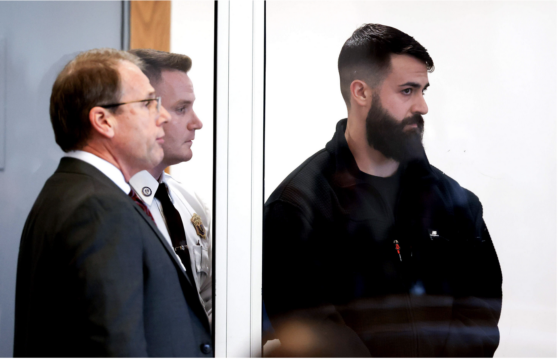
Officer Nicholas O’Malley, 33, pleaded not guilty and was released following his arraignment Thursday in Roxbury Municipal Court. He’s charged in the death of Stephenson King, 39, who was shot March 11 while he allegedly tried to flee a traffic stop in a stolen car.
O’Malley told investigators he fired because he feared for the life of another officer on the scene, believing his colleague was about to be run over.
But Assistant District Attorney Ian Polumbaum said in court that investigators determined O’Malley’s explanation wasn’t reasonable, citing witness testimony and footage from police body cameras.
The other officer, Polumbaum said, “was in greater danger of being struck by those bullets than he ever was by the car.” While the law affords police officers deference for split-second decisions, he said, “We keep in mind the law and common sense.”
Commissioner Michael Cox said in a statement Thursday that it was “a difficult day for our department and our city.” While he would not comment on the shooting because it is a criminal matter, Cox stressed the department remains “committed to our mission of building trust” with the community.
“We rely on the integrity of the criminal justice system in what we do every day, and this case will be no different,” Cox said, expressing sympathies “to all of those impacted.”
Ahead of Thursday’s arraignment, dozens of Boston police officers lined the courtroom, many in uniform, to show support for their colleague.
In a statement to reporters after the hearing, O’Malley’s attorney, Ken Anderson, said body camera footage does not capture what the officer experienced and feared in real time, and noted O’Malley also voluntarily provided investigators a statement soon after the shooting.
“That body-worn camera does not have human adrenaline,” he said. “That body-worn camera isn’t worried about going home safe at night.”
Police had pursued King after he allegedly committed a carjacking outside a pizza restaurant in Boston’s Mission Hill neighborhood around 9:45 p.m. The mother of a restaurant employee who was parked outside was approached by a man who demanded the vehicle, a manager told the Globe. About 15 minutes later, officers stopped the stolen car less than a mile away, at Linwood Square in Roxbury.
The driver ignored “multiple verbal commands” as officers approached the car on foot and then tried to drive away, Cox said at the scene. A nearby resident who witnessed the shooting told the Globe the situation escalated extremely quickly.
According to a police report filed Thursday, King opened the car window at the command of police officers, but did not turn the vehicle off. Positioned outside the driver’s side window, O’Malley drew a department-issued Taser and shouted, “Bro, I’m going to [expletive] shoot you,” according to the police report.
At that moment, King backed into the cruiser behind him, then maneuvered the vehicle forward and back “in an attempt to escape the police,” according to the report.
As King started to drive forward again, O’Malley drew his gun and fired three shots through the driver’s window, striking King, according to the report. He was taken to a Boston hospital, where he was pronounced dead.
Immediately after firing the shots, O’Malley called over his radio that officers were involved in a shooting and the suspect “tried to run us over,” according to the police report. He later told investigators he believed the other officer “was going to be crushed by the suspect’s vehicle,” according to the report.
However, investigating officers wrote that O’Malley’s statement “was not factually true.” State law and Boston Police Department policy forbid officers from shooting at a moving vehicle unless there’s no other way to prevent “imminent harm to a person.”
And on Thursday, responding to a question from reporters about whether the officers should have allowed the suspect to drive away, Suffolk District Attorney Kevin Hayden said, “In this circumstance, that might have been prudent.”
King’s family declined to comment when reached at their home Thursday.
O’Malley appeared in court wearing a dark jacket. He stood quietly next to his attorney, nodding to show he understood the outcome of the hearing.
Prosecutors requested $25,000 bail, which they said was about one-eighth of O’Malley’s annual pay last year, which exceeded $200,000. Instead, Judge Steven Kim agreed with O’Malley’s attorney and released him on personal recognizance, under the condition he surrender his firearms.
Anderson, O’Malley’s attorney, said the officer has an “unblemished record during nearly six years with the department.” He briefly worked as a police officer in Providence before joining the Boston police.
Anderson said it’s “very rare” for prosecutors to bring such a charge without first having a grand jury consider the evidence. He suggested politics could have factored into the charging decision: “I don’t know if it’s because this is an election year or not,” he said.
Hayden said the case will go before a grand jury as it proceeds, which is common practice in the Massachusetts court system. He said O’Malley isn’t being treated differently from any other defendant.
As for politics, Hayden denied the accusation, saying the prosecution “has nothing to do with public opinion” or any other outside factors.
The prosecution drew sharply different responses from different ends of city government.
Larry Calderone, president of the Boston Police Patrolmen’s Association, called the prosecution “a complete tragedy” and a slap in the face to other law enforcement officers. While “no officer ever wants to take a life,” he said, they carry department-issued firearms to keep the public safe.
He also noted that King was “no stranger to the criminal justice system,” and was facing other charges for assaults and firearms possession.
“Is this an outrage? Absolutely it is,” Calderon said after the arraignment. “It makes the job of these men and women so much more difficult.”
But City Councilor Miniard Culpepper, who attended the hearing, thanked prosecutors for “swiftly moving to charge the officer.”
“I think in this case, Kevin Hayden saw the facts and made a decision that this was the right thing to do,” Culpepper said. He commended witnesses who came forward during the investigation. Culpepper had previously called for the release of bodycam footage from the shooting.
Boston police officers have faced criminal charges in recent years for financial crimes and off-duty incidents, but not for on-duty use of force.
The last time one was charged in an on-duty fatal shooting was in 1991. In that case, officer James E. Hall shot and killed an unarmed Dorchester teenager following a foot chase. Hall claimed his gun accidentally discharged when he lost his balance while crouching to peer under a car. He was ultimately convicted of involuntary manslaughter and sentenced to 5 to 10 years in prison.
In 2002, the Suffolk district attorney’s office opened a grand jury investigation into the killing of Willie Murray Jr. by a Boston police officer. Murray was also shot while fleeing police in his car. But the grand jury declined to indict.
Travis Andersen of the Globe staff contributed to this report.