
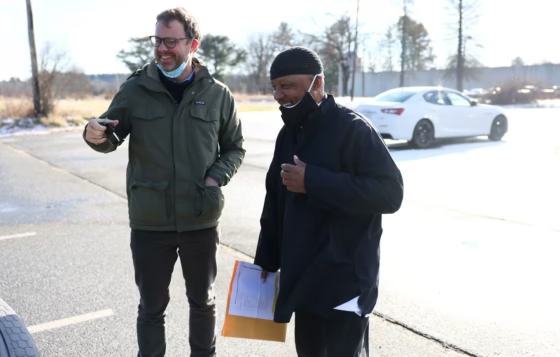
[Source via Boston Globe by Niki Griswold]
The City of Boston last year paid $11 million to a man who spent nearly 40 years in prison before a court vacated his conviction, adding to a wave of high-dollar agreements it has reached with those who had murder verdicts overturned after serving decades-long sentences.
Joseph Jabir Pope was incarcerated for 37 years for first-degree felony murder before a judge threw out his conviction in 2022 because prosecutors withheld important evidence in his case. He filed a federal lawsuit against the city in 2024, alleging misconduct by several police officers and detectives, including that they did not share evidence that could have helped Pope’s defense.
The city and Pope, 73, reached a settlement last August, according to court records. The Globe learned of the agreement after acquiring a list of city settlements spanning several months in 2025 through a public records request.
The records showed the city made an $11 million payout for what was described as a “civil rights discrimination” matter involving Boston police. But they did not identify who had received the settlement.
The Globe confirmed Pope was the recipient after obtaining a copy of the seven-page settlement. City officials did not publicly announce the agreement at the time, and it has not previously been reported.
According to the settlement, the city did not admit to any wrongdoing. The settlement also says that the decision to pay the $11 million is “not to be construed as an admission of liability” by the city or the officers and detectives named.
The city made the payment “solely” to avoid the cost of further litigation, and it denies “any wrongdoing, alleged unlawful conduct, and/or liability for any injury or damage,” according to the settlement.
A spokesperson for Mayor Michelle Wu’s office declined to comment. Attorneys who represented Pope did not respond to multiple requests for comment.
Rahsaan Hall, president of the Urban League of Eastern Massachusetts, said he’s glad the city opted to pay Pope rather than continue what would have likely been a long legal fight.
“I don’t think that there’s any dollar amount that could adequately compensate him for being denied his liberty and subjected to the horror and trauma of incarceration — and wrongful incarceration at that — for nearly four decades,” Hall said.
Pope was convicted four decades ago of first-degree felony murder but was released from prison in 2021 after the state’s high court found prosecutors withheld important exculpatory evidence during his trial.
The Suffolk County district attorney’s office later decided not to pursue a new case against him, saying a new trial was “not in the best interest of justice.”
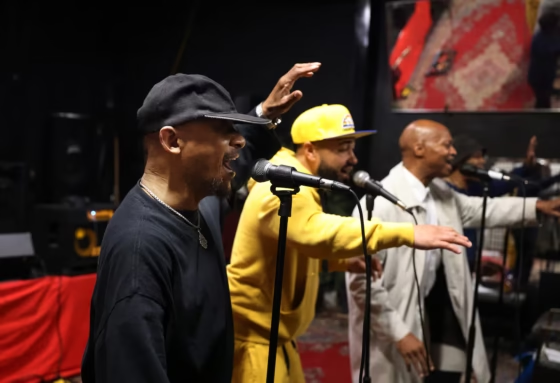
Pope’s case was featured in a Boston Globe Spotlight Team report in 2022that examined people incarcerated for life under now-abolished first-degree felony-murder rules.
Pope was accused of participating in the May 23, 1984, armed robbery of Efrain DeJesus, who was allegedly shot to death by a man named Floyd Hamilton. Hamilton was convicted of first-degree murder in a separate trial and also had a new trial ordered in 2022.Suffolk District Attorney Kevin Hayden later announced that his office would also not move to retry Hamilton.
The key testimony against Pope was provided by Efrain Dejesus’s brother, Bienvenido DeJesus.
Pope, a US Marine veteran, maintained for decades that he was not involved in any armed robbery or murder. He said he and a friend were at the Dorchester house, one floor up from where the killing happened, to buy cocaine to resell.
In his lawsuit against the city, Pope accused Boston police of having “coerced and induced” Bienvenido DeJesus into fabricating evidence that Pope participated in a robbery plan. The lawsuit charged that some Boston police detectives had a “practice, policy, and custom of fabricating evidence where needed and suppressing exculpatory evidence.”
“The City of Boston was, or should have been, aware of the potential for misconduct and the actual misconduct of its officers, but failed to act,” the lawsuit reads.
Pope’s lawsuit names several Boston police officials, including Detective Peter O’Malley, accusing them of misconduct. O’Malley, a controversial investigator who died in 2017, was involved in investigations that led to several murder convictions that were later overturned.
Since his release from prison, Pope has found comfort in music — a pastime that also brought him relief during his many years behind bars. A longtime R&B fan, Pope put together a band, known as the OG’s, with a fellow inmate while incarcerated in MCI-Norfolk, the Globe has reported.
He told the Globe in 2024 that prison officials let them put on performances a handful of times every year, including on Martin Luther King Jr. Day, and during Black History Month.
“It became our therapy, to a large extent,” Pope told the Globe two years ago.
It had beenespecially meaningful after the years Pope spent fighting his sentence, fiercely maintaining his innocence in the crime for which he was convicted.
“Innocent prisoners generally do time differently than guilty prisoners,” Pope told the Globe for a Spotlight report in 2022. “I know that because I’ve been both. Those that are guilty tend to resolve themselves to their fate and on some level even find relief. With innocent prisoners, there’s a hunger and rage that accompanies us on a regular basis.”
The $11 million payout to Pope adds to a series of high-profile settlements the city has reached in recent years. The city in 2024 paid $12 million to settle a lawsuit brought by Shaun Jenkins, who spent nearly 19 years in prison for a murder he said he did not commit, though the agreement only came to light in April when the Globe obtained a copy of it through a public records request.
In 2023, the Globe reported that the city two years earlier had quietly reached a $16 million settlement for wrongdoing by the Police Department with Sean Ellis, which at the time was the largest single legal payout the city had made in recent years, according to figures the Globe obtained through a public records request.
Ellis had served 22 years in prison before his murder conviction was eventually overturned in a protracted case that later was the focus of a Netflix docuseries.
The same year the city settled with Ellis, Boston paid another $4 million to James Watson, who spent more than 40 years in prison after being wrongfully convicted in 1984 of killing Boston cab driver Jeffrey S. Boyajian.
Frederick Clay was wrongfully convicted in that same case and spent 38 years behind bars. The city agreed to pay Clay $3.1 million in 2020.
While these cases have received media attention and the victims received payments from the city, Hall, the Urban League president, said that there are far more people who are still wrongfully incarcerated.
“It continues to raise a larger question about how much we invest in policing and the criminalization of communities,” said Hall, who previously led the Racial Justice Program at the ACLU of Massachusetts. “Not only does it cost us on the front end, but it also costs us on the back end, when cities and municipalities have to pay out these large sums to try to correct or compensate people for grave injustice that was done.”
Niki Griswold can be reached at niki.griswold@globe.com. Follow her @nikigriswold.