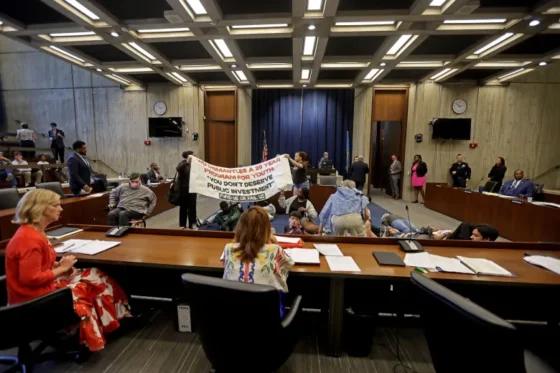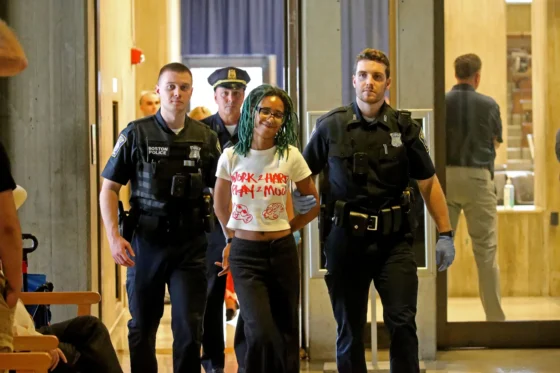
Eight people were arrested at Boston City Hall Wednesday after a City Council meeting was interrupted by activists protesting the city budget for about two hours.
After all that drama, the Council passed Mayor Michelle Wu’s $4.9 billion budget overwhelmingly, 12-1, with nearly $11.2 million in amendments. Councilor Julia Mejia cast the lone ‘no’ vote. The budget is growing by 2.1%. Wu can now accept or veto Council amendments.
The arrests were made shortly before 5 p.m., and soon after a warning was issued by City Council President Liz Breadon, who had been forced to call multiple recesses that stretched for roughly two hours due to the interruption.
“We have a hard deadline to amend the budget … midnight tonight,” Breadon said. “I’m asking you now for the last time to stand up and leave peacefully. Otherwise, — this is your last warning — we’re going to ask the police department to remove you.”
Boston Police SGT. Det. John Boyle, a department spokesperson, said there would not be information available on charges and identifying information on the eight people arrested until late Wednesday night, but said they were all adults.
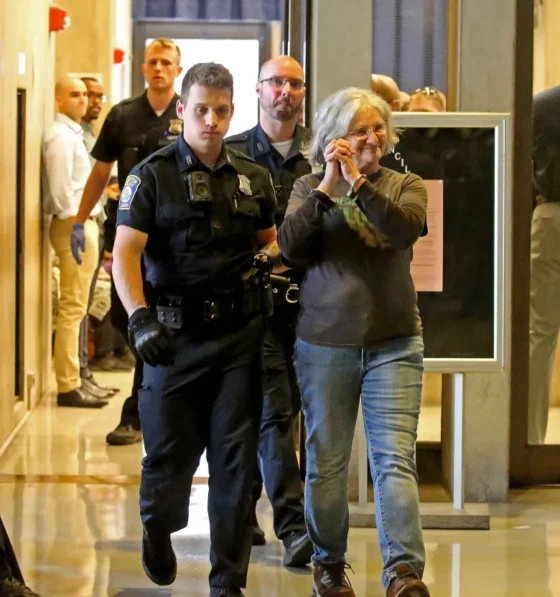
After the eight protesters were cuffed and led out of the Council chamber by police, they were cheered by people gathered in the hallway as they were escorted out of City Hall by officers, per a video captured by a Herald photographer.
Activists, some of whom were city youth, began their protest soon after debate began on Mayor Wu’s budget, which the Council had until the end of Wednesday to amend, approve or reject.
The clash capped a chaotic budget process fueled by community opposition over grant funding and youth job cuts, along with about 400 layoffs at Boston Public Schools.
Protesters called out councilors who voted against a Council motion to reject the budget last month by name, shouting after each councilor’s name, “You failed us.”
The motion to reject the budget failed, when the Council deadlocked, 6-6, with all councilors voting against the motion considered to be allies of Wu.
The protest escalated quickly, with many activists lying in the middle of the Council chamber floor, in between the tables where councilors sit each meeting — an area that is off-limits to the public unless otherwise invited by officials.
Chants kept up over the efforts of Breadon to restore order and get the meeting back in session, forcing her to call a recess.
“Tell us where the money goes,” the activists chanted.
Mejia, who had been calling for the Council to reject the mayor’s budget, joined in the chants and live-streamed the protest on social media. Councilor Brian Worrell sat on the floor and spoke with the protesters lying down at one point.
Some protesters heeded Breadon’s warning to leave the chamber to avoid being arrested, but a small group remained. A person in a wheelchair was one of the protesters who remained and was handcuffed.
The right to peacefully protest is protected by the First Amendment, but not when that demonstration interrupts a government meeting.
The public meeting of a board or council is considered a “limited public forum,” which means the government can regulate the time, place and manner of speech, according to the nonprofit Municipal Research and Services Center.
A 2013 court ruling held that the First Amendment requires that a person’s speech in a city council meeting must actually disrupt a meeting before that person may be removed from the meeting.
Upon resuming the meeting, Breadon didn’t directly address the arrests, but said no further interruptions would be tolerated, per Council rules.
“This rule will be strictly enforced,” Breadon said. “There will be no more warnings. If you make a disturbance or a distraction, you will be escorted out.”
Councilor Erin Murphy thanked Boston Police and City Hall security officers for their professionalism to get the meeting back in session, “because if we don’t work together and get to a vote by midnight tonight, this budget will just go into effect without our amendment process.”
The arrests are the latest chaos to plague the City Council’s budget process, which has left the body deeply divided over how to restore Wu’s grant funding cuts.
On Monday, Council Ways and Means Chair Ben Weber disclosed publicly that the state Ethics Commission had raised concerns about his oversight of a Council budget process that could financially benefit an immigration nonprofit his wife, Alexandra Weber, works for.
Weber said he decided to remove an amendment he proposed that would have restored $1.2 million in grant funding cuts to the Mayor’s Office for Immigrant Advancement, based on guidance he received from the state Ethics Commission.
Citing that guidance on Wednesday, Weber recused himself from discussions and votes that came up when his colleagues put forward an amendment to restore that funding, given his wife’s executive role with the International Institute of New England, a nonprofit that receives city grant funding from MOIA.
The $1.2 million MOIA amendment was approved, 12-0, by the Council, with Weber recorded as absent. John FitzGerald, the vice chair of Ways and Means, put forward the amendment.
Weber came back into the room after the MOIA amendment was approved, and had said Tuesday he planned to vote on the total budget, citing clearance by the state Ethics Commission.
The Council then continued debate on Weber’s initial $8.1 million amendment package to the mayor’s budget. Other councilors proposed nine additional amendments to Weber’s proposal, but only two passed.
Wu’s financial chief Ashley Groffenberger on Monday urged the City Council to stick to an $8-9 million budget amendment package proposed by Weber, warning that further changes proposed by other councilors would lead to city layoffs and impact revenue collection.